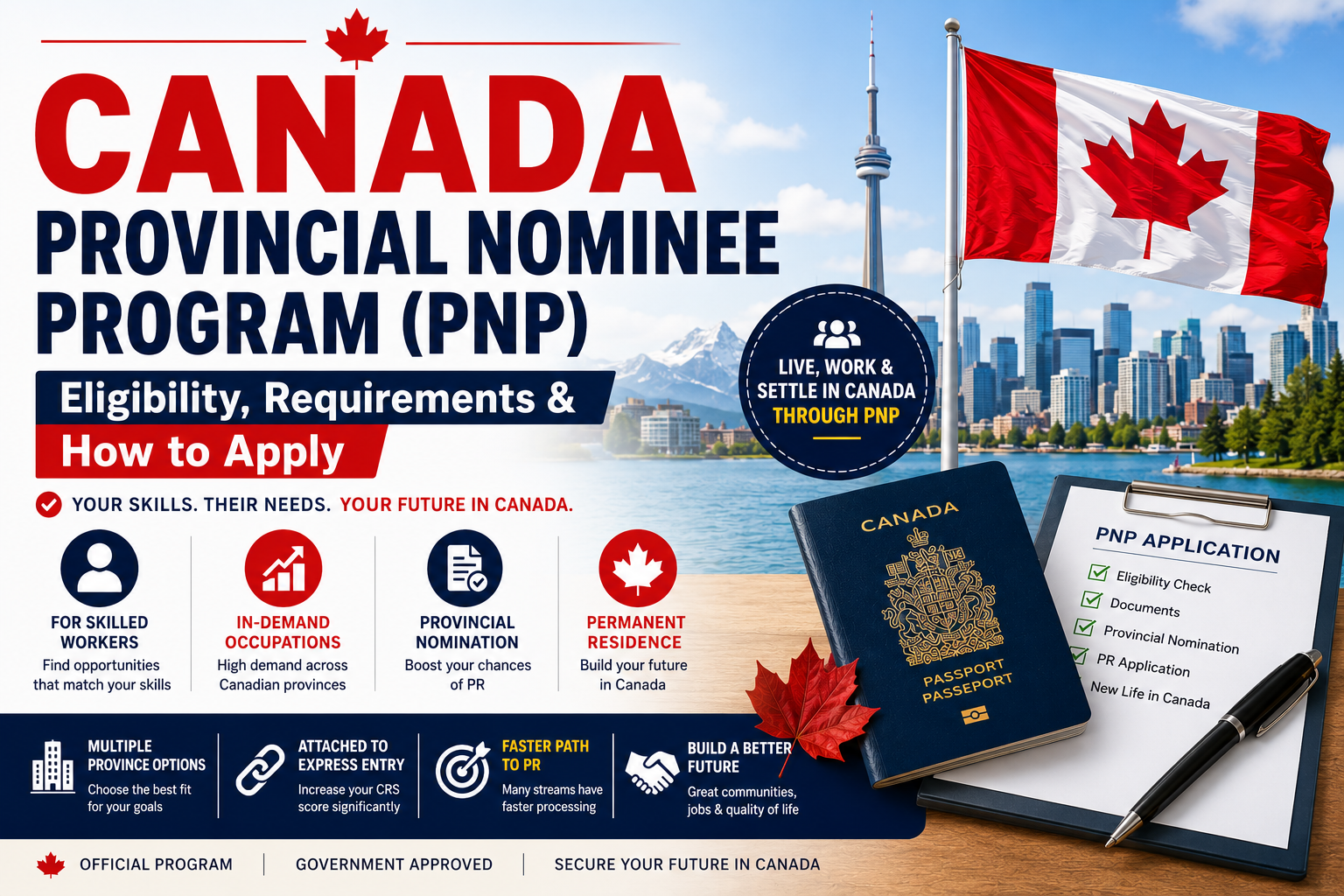
Canada Provincial Nominee Program (PNP) | Eligibility, Requirements & How to Apply for Canada’s Provincial Nominee Program (PNP) has become one of the most attractive immigration pathways for skilled workers, international graduates, entrepreneurs, and certain in-demand occupations. While Canada’s Express Entry system receives much of the attention, Provincial Nominee Programs offer another excellent opportunity for individuals whose skills match the labour needs of a specific province or territory. In many cases, receiving a provincial nomination can significantly improve your chances of becoming a Canadian permanent resident.
Suggestion: Canada Express Entry: Eligibility, CRS Score & Step-by-Step Application Process
Suggestion: Canada Immigration Requirements: Eligibility, Visa Options & Application Process
Each province designs its own immigration streams based on local economic priorities. This means eligibility requirements, occupations in demand, and application procedures can vary depending on where you plan to live and work. Understanding these differences will help you choose the pathway that best fits your qualifications and career goals.
What Is the Provincial Nominee Program (PNP)?
The Provincial Nominee Program (PNP) allows Canadian provinces and territories to nominate qualified foreign nationals for permanent residence based on regional labour market needs. Most provinces operate multiple immigration streams for skilled workers, graduates, entrepreneurs, healthcare professionals, tradespeople, and other priority occupations.
Many PNP streams are linked to Canada’s Express Entry system, while others accept direct applications outside Express Entry.
PNP Eligibility Checker
Before applying, review this basic checklist.
✔ Valid passport
✔ Skilled work experience
✔ Educational qualifications
✔ Language test results (IELTS, CELPIP, or TEF where required)
✔ Occupation matches provincial demand
✔ Settlement funds (if applicable)
✔ Genuine intention to live in the nominating province
✔ Medical examination
✔ Police clearance certificate
Meeting these requirements does not guarantee nomination, but it helps determine whether you may qualify for one or more provincial streams.
Popular Provincial Nominee Programs
Each province targets different industries and workforce shortages.
Ontario Immigrant Nominee Program (OINP)
Ontario attracts professionals in:
- Information Technology
- Healthcare
- Finance
- Engineering
- Skilled Trades
Ontario frequently selects candidates through both Express Entry-linked and employer-driven streams.
British Columbia Provincial Nominee Program (BC PNP)
British Columbia is well known for opportunities in:
- Technology
- Construction
- Healthcare
- Tourism
- Childcare
The BC PNP regularly invites workers with skills needed across the province.
Alberta Advantage Immigration Program (AAIP)
Alberta continues to recruit workers in sectors including:
- Energy
- Agriculture
- Engineering
- Construction
- Healthcare
Some Alberta streams have invited candidates with CRS scores lower than typical federal Express Entry draws.
Saskatchewan Immigrant Nominee Program (SINP)
Saskatchewan actively recruits skilled workers for occupations experiencing labour shortages.
Popular industries include:
- Agriculture
- Healthcare
- Transportation
- Skilled Trades
- Manufacturing
Manitoba Provincial Nominee Program (MPNP)
Manitoba offers pathways for:
- Skilled workers
- International graduates
- Business investors
- Family connections
The province continues to experience demand across manufacturing, logistics, healthcare, and agriculture.
Province Comparison Table
| Province | Key Industries | Popular PNP Streams | Cost of Living |
|---|---|---|---|
| Ontario | Technology, Finance, Healthcare | Human Capital Priorities | High |
| British Columbia | Technology, Construction, Tourism | Skilled Worker Stream | High |
| Alberta | Energy, Agriculture, Engineering | Alberta Opportunity Stream | Moderate |
| Saskatchewan | Agriculture, Trades, Healthcare | Occupation In-Demand | Lower |
| Manitoba | Manufacturing, Logistics, Agriculture | Skilled Worker Stream | Lower |
| Nova Scotia | Healthcare, IT, Education | Labour Market Priorities | Moderate |
Choosing the right province depends on your occupation, career goals, and preferred lifestyle.
Occupations Frequently Targeted by PNPs
While occupation lists change regularly, these professions are commonly in demand.
| Occupation | Typical Demand |
|---|---|
| Registered Nurse | Very High |
| Software Developer | High |
| Electrician | High |
| Heavy Equipment Mechanic | High |
| Welder | High |
| Truck Driver | High |
| Construction Manager | High |
| Accountant | Moderate |
| Early Childhood Educator | High |
| Pharmacist | Moderate to High |
Applicants should always verify current occupation lists before applying.
Estimated Salary Examples
Actual salaries depend on province, employer, experience, certifications, and labour market conditions.
| Occupation | Estimated Annual Salary (CAD) |
|---|---|
| Registered Nurse | $75,000–$105,000 |
| Software Developer | $80,000–$130,000 |
| Electrician | $65,000–$100,000 |
| Heavy Equipment Mechanic | $70,000–$110,000 |
| Welder | $55,000–$90,000 |
| Truck Driver | $55,000–$90,000 |
| Accountant | $60,000–$95,000 |
| Construction Manager | $90,000–$140,000 |
These figures are approximate market ranges and may vary by province and employer.
Required Documents
Although each province has unique requirements, applicants commonly need:
- Valid passport
- Educational Credential Assessment (ECA), if applicable
- Language test results
- Employment reference letters
- Resume or CV
- Police clearance certificate
- Medical examination
- Proof of settlement funds (where required)
- Provincial nomination forms
- Marriage certificate (if applicable)
- Children’s birth certificates (if applicable)
Submitting complete and accurate documentation helps reduce processing delays.
Step-by-Step Application Process
Step 1: Choose a Province
Research provinces based on labour demand, lifestyle, and your occupation.
Step 2: Confirm Eligibility
Review the eligibility criteria for the specific provincial stream you intend to apply under.
Step 3: Prepare Your Documents
Gather all required documents before submitting your application.
Step 4: Submit Your Provincial Application
Apply through the province’s official immigration portal or Express Entry-linked system, depending on the stream.
Step 5: Receive a Provincial Nomination
If approved, you’ll receive a provincial nomination certificate. For Express Entry-linked streams, this nomination can substantially increase your CRS score.
Step 6: Apply for Permanent Residence
After nomination, submit your permanent residence application to Immigration, Refugees and Citizenship Canada (IRCC).
Employers That Commonly Hire International Talent
Canadian employers recruit based on business needs and legal hiring requirements. Examples of well-known employers across sectors include:
- Alberta Health Services
- Fraser Health
- Vancouver Coastal Health
- Loblaw Companies
- Sobeys
- Maple Leaf Foods
- Magna International
- Amazon Canada
- RBC
- TD Bank
Employment opportunities vary by province, occupation, and recruitment needs. A job offer is not required for every PNP stream.
Recent Provincial Immigration Trends
Canadian provinces continue to adapt immigration programs to address workforce shortages.
Recent priorities include:
- Healthcare professionals
- Skilled trades
- Technology workers
- Transportation and logistics
- Construction
- Early childhood education
- Agriculture and food processing
Eligibility requirements and occupation lists are updated periodically, so applicants should review official provincial websites before applying.
Tips to Improve Your Chances
You may strengthen your application by:
- Improving language test scores.
- Gaining additional work experience.
- Obtaining a provincial job offer where applicable.
- Keeping your Express Entry profile updated.
- Researching provinces with demand for your occupation.
- Preparing complete supporting documents.
Frequently Asked Questions
What is a Provincial Nominee Program (PNP)?
A Provincial Nominee Program allows Canadian provinces and territories to nominate eligible foreign nationals for permanent residence based on regional labour market needs.
Do I need a job offer to apply for a PNP?
Not always. Some PNP streams require a valid job offer, while others accept qualified applicants without one if they meet specific eligibility criteria.
Which province has the easiest PNP?
There is no universally easiest province. Eligibility depends on your occupation, work experience, language ability, education, and current provincial labour needs.
Does a provincial nomination increase my Express Entry score?
Yes. An eligible Express Entry-aligned provincial nomination generally provides additional Comprehensive Ranking System (CRS) points under current IRCC rules, greatly improving the likelihood of receiving an Invitation to Apply.
How long does the PNP process take?
Processing times vary by province, immigration stream, application completeness, and IRCC processing volumes.
Related Articles
- Canada Express Entry: Eligibility, CRS Score & Step-by-Step Application Process
- Canada Immigration Requirements: Eligibility, Visa Options & Application Process
- Canada LMIA Work Permit: Eligibility, Requirements & Application Process
- How to Apply for a Work Visa
- How to Apply for a Student Visa
- Best Countries With Easy Tourist Visa Approval
Authoritative Resources
- Immigration, Refugees and Citizenship Canada (IRCC): https://www.canada.ca/en/services/immigration-citizenship.html
- Provincial Nominee Program Information: https://www.canada.ca/en/immigration-refugees-citizenship/services/immigrate-canada/provincial-nominees.html
- Ontario Immigrant Nominee Program: https://www.ontario.ca/page/ontario-immigrant-nominee-program-oinp
- British Columbia Provincial Nominee Program: https://www.welcomebc.ca/Immigrate-to-B-C
Disclaimer: This article is for informational purposes only and is not legal or immigration advice. Provincial immigration programs, eligibility requirements, occupation lists, and processing times change periodically. Always verify the latest information through the official provincial immigration websites and Immigration, Refugees and Citizenship Canada (IRCC) before applying.