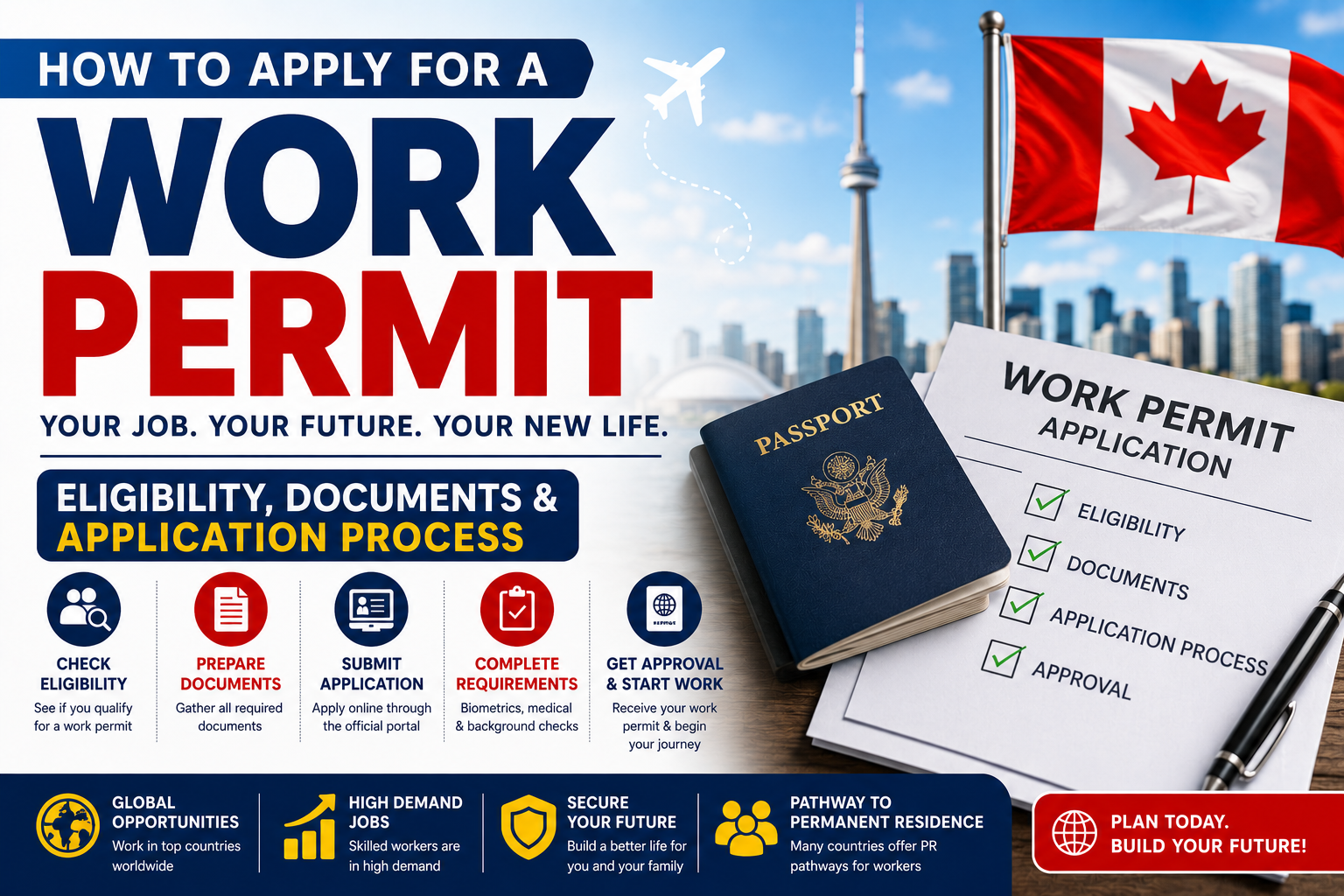
How to Apply for a Canada Work Permit: Eligibility, Documents & Application Process. A work permit allows eligible foreign nationals to work legally in another country for a specific employer or under an approved immigration program. Whether you’re planning to work in Canada, the United States, the United Kingdom, Australia, Germany, or another popular destination, understanding the application process before you apply can save time and help you avoid common mistakes.
Suggestion: Canada LMIA Work Permit: Eligibility, Requirements & Application Process
Suggestion: Canada Express Entry: Eligibility, CRS Score & Step-by-Step Application Process
Every country has its own immigration rules, but most work permit applications follow similar principles. Employers often need to verify labour shortages, applicants must prove their qualifications, and immigration authorities review supporting documents before issuing approval. This article explains the general work permit process, required documents, employer examples, salary expectations, province comparisons, and practical tips to help you prepare a stronger application.
What Is a Work Permit?
A work permit is an official authorization that allows a foreign national to work legally in another country for a specified period.
Depending on the destination country, work permits may be:
- Employer-sponsored
- Open work permits
- Skilled worker permits
- Temporary work permits
- Seasonal work permits
- Occupation-specific permits
Some countries also provide pathways from temporary work permits to permanent residence.
Work Permit Eligibility Checker
Use this checklist before starting your application.
✔ Valid passport
✔ Job offer (where required)
✔ Relevant education or professional qualifications
✔ Work experience
✔ Good health (medical examination if required)
✔ Police clearance certificate (where requested)
✔ Proof of financial support if applicable
✔ Meet immigration requirements for your destination country
Meeting these requirements does not guarantee approval, but it can help determine whether you’re ready to apply.
Step-by-Step Work Permit Application Process
Step 1: Choose the Right Work Permit
Identify the work permit category that matches your situation. Some permits require employer sponsorship, while others may be available through government programs or international agreements.
Step 2: Confirm Your Eligibility
Review the official eligibility requirements published by the immigration authority of your chosen country.
Step 3: Receive a Job Offer (If Required)
Many countries require applicants to have a genuine job offer before submitting a work permit application.
Step 4: Gather Supporting Documents
Prepare all required documents before submitting your application to avoid unnecessary delays.
Step 5: Submit Your Application
Applications are generally submitted online through the official immigration website or visa application centre.
Step 6: Complete Biometrics and Medical Examination
Many countries require fingerprints, photographs, and medical examinations depending on the applicant’s nationality and occupation.
Step 7: Wait for Processing
Processing times vary depending on the country, visa category, application volume, and security checks.
Required Documents
Document requirements vary by country, but commonly include:
- Valid passport
- Job offer letter (if required)
- Employment contract
- Resume or CV
- Educational certificates
- Professional licences (where applicable)
- Police clearance certificate
- Immigration medical examination results
- Passport-sized photographs
- Proof of financial resources (if required)
- Marriage certificate (if applicable)
- Children’s birth certificates (if applicable)
Always verify the latest requirements with the official immigration authority before applying.
Occupations Frequently Eligible for Work Permits
Many countries recruit international workers to address labour shortages.
| Occupation | Global Demand |
|---|---|
| Registered Nurse | Very High |
| Software Developer | Very High |
| Electrician | High |
| Welder | High |
| Construction Worker | High |
| Truck Driver | High |
| Mechanical Engineer | High |
| Caregiver | High |
| Chef | Moderate to High |
| Agricultural Worker | Seasonal |
Demand varies by country and region.
Employer Examples
Many organizations recruit internationally depending on labour market needs.
Examples include:
- Hospitals and healthcare providers
- Construction companies
- Manufacturing firms
- Logistics and transportation companies
- Hotels and hospitality businesses
- Technology companies
- Agricultural employers
- Food processing companies
- Engineering firms
- Mining and energy companies
Always apply through official employer career pages or recognized recruitment channels.
Estimated Salary Comparison
Actual salaries depend on occupation, employer, experience, and location.
| Occupation | Estimated Annual Salary (USD Equivalent) |
|---|---|
| Registered Nurse | $60,000–$100,000 |
| Software Developer | $70,000–$130,000 |
| Mechanical Engineer | $65,000–$110,000 |
| Electrician | $50,000–$90,000 |
| Truck Driver | $45,000–$85,000 |
| Welder | $45,000–$80,000 |
| Construction Worker | $40,000–$75,000 |
| Caregiver | $35,000–$60,000 |
Salary ranges are approximate and vary by country and employer.
Province Comparison (Canada Example)
For applicants considering Canada, employment opportunities differ by province.
| Province | High-Demand Industries | Employment Outlook |
|---|---|---|
| Ontario | Technology, Healthcare, Finance | Excellent |
| British Columbia | Construction, Tourism, IT | Strong |
| Alberta | Energy, Skilled Trades | Strong |
| Saskatchewan | Agriculture, Healthcare | Good |
| Manitoba | Manufacturing, Logistics | Good |
| Nova Scotia | Healthcare, Education | Growing |
Research local labour market conditions before accepting a job offer.
Tips to Strengthen Your Application
Increase your chances by:
- Applying only for jobs matching your qualifications.
- Preparing a professional, country-specific resume.
- Improving your English or French language skills where beneficial.
- Keeping all documents accurate and up to date.
- Responding promptly to requests from immigration authorities.
- Reviewing application forms carefully before submission.
Common Mistakes to Avoid
Many work permit applications are delayed because applicants:
- Submit incomplete documents.
- Use expired passports.
- Provide inconsistent employment histories.
- Apply under the wrong visa category.
- Miss document deadlines.
- Rely on unofficial information.
Careful preparation helps reduce delays and unnecessary complications.
Recent Policy Information
Many countries continue updating work permit policies to address labour shortages and changing economic priorities.
Recent trends include:
- Increased recruitment in healthcare.
- Greater demand for skilled trades.
- Expanded technology occupation lists.
- Faster digital application systems.
- Enhanced employer compliance requirements.
- New pathways from temporary work permits to permanent residence in some countries.
Applicants should always verify the latest immigration updates before applying.
Why Trust Our Information?
Our content is based on publicly available information from official immigration authorities and trusted government publications.
We focus on:
- Accuracy
- Transparency
- Easy-to-understand explanations
- Responsible immigration education
- Regular updates
Our goal is to help readers understand immigration processes—not to promise employment or visa approval.
Frequently Asked Questions
Who can apply for a work permit?
Eligibility depends on the country and visa category. Common requirements include a valid passport, relevant qualifications, work experience, and, in many cases, a genuine job offer.
Do all work permits require employer sponsorship?
No. Some countries offer open work permits or special work authorization programs that do not require employer sponsorship. Requirements vary by jurisdiction.
Can a work permit lead to permanent residence?
In some countries, qualifying work experience may support future permanent residence applications, subject to immigration program rules.
How long does work permit processing take?
Processing times vary depending on the country, application type, background checks, and application volume.
Can I change employers while on a work permit?
This depends on the conditions attached to your work permit. Some permits are employer-specific, while others provide greater flexibility.
Related Articles
- Canada LMIA Work Permit: Eligibility, Requirements & Application Process
- Canada Express Entry: Eligibility, CRS Score & Step-by-Step Application Process
- Canada Immigration Requirements: Eligibility, Visa Options & Application Process
- How to Apply for a Student Visa
- How to Apply for a Tourist Visa
- Dependent Visa Requirements: Who Can Apply and How to Get Approved
Authoritative Resources
- Immigration, Refugees and Citizenship Canada (IRCC): https://www.canada.ca/en/services/immigration-citizenship.html
- U.S. Citizenship and Immigration Services (USCIS): https://www.uscis.gov
- UK Visas and Immigration (UKVI): https://www.gov.uk/browse/visas-immigration
- Australian Department of Home Affairs: https://immi.homeaffairs.gov.au
Disclaimer: This article is provided for general educational purposes only and should not be considered legal or immigration advice. Immigration laws, eligibility criteria, and work permit policies differ by country and may change over time. Always consult the official immigration authority of your intended destination for the latest requirements, forms, fees, and processing information before submitting an application.