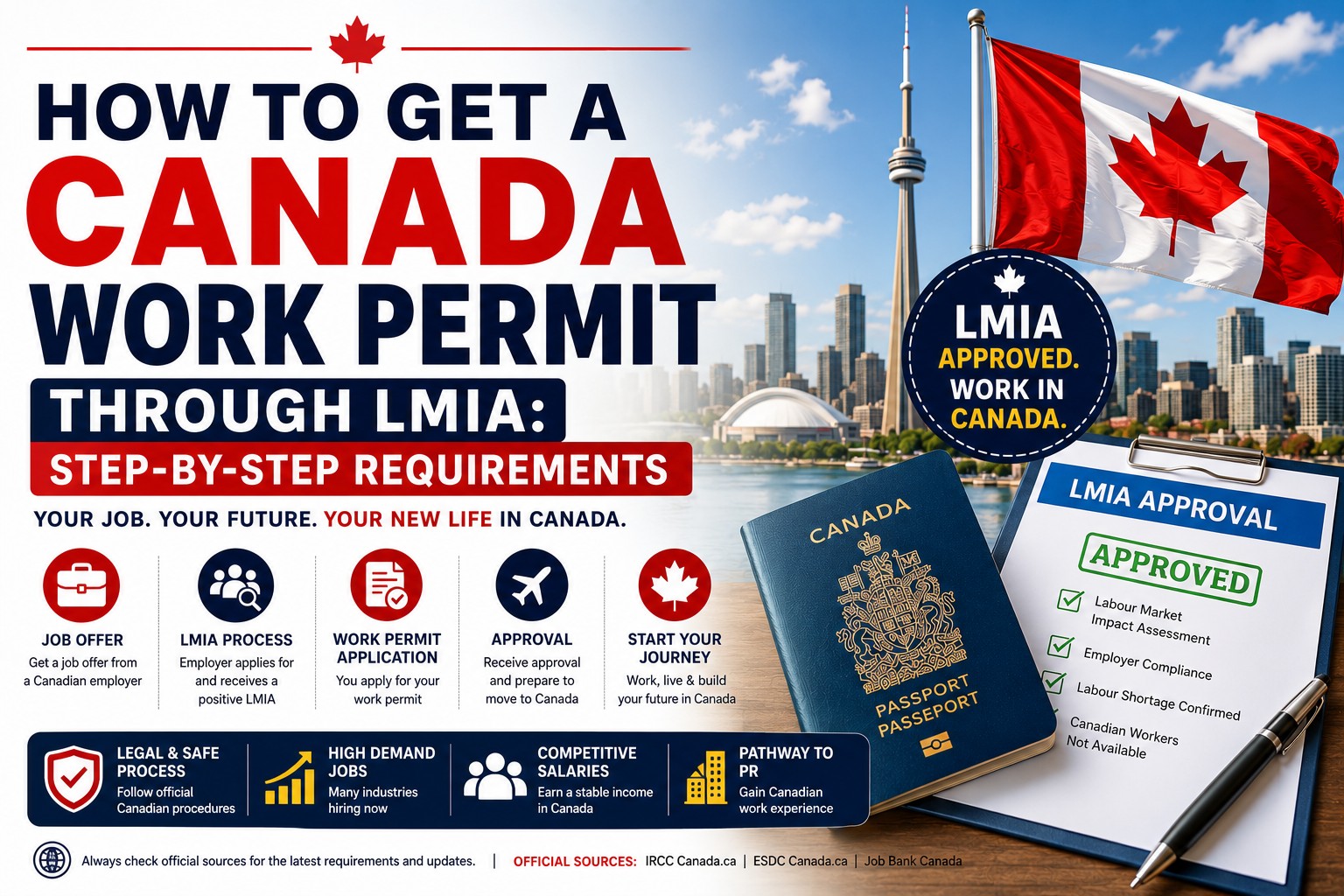
How to Get a Canada Work Permit Through LMIA: Step-by-Step Requirements as Canada continues to attract skilled workers from around the world, and one of the most common pathways to employment is through a Labour Market Impact Assessment (LMIA)-supported work permit. If you’ve received interest from a Canadian employer or you’re actively searching for jobs that hire foreign workers, understanding how the LMIA process works can help you prepare for a successful application.
Suggestion: Canada Express Entry: Eligibility, CRS Score & Step-by-Step Application Process
Suggestion: Canada Immigration Requirements: Eligibility, Visa Options & Application Process
An LMIA does not guarantee that you’ll receive a work permit or permanent residence. Instead, it is an assessment that, in many cases, allows a Canadian employer to hire a foreign worker when no qualified Canadian citizen or permanent resident is available for the position. This article explains eligibility, required documents, employer examples, salary expectations, province comparisons, and practical steps to help you understand the process.
What Is an LMIA?
A Labour Market Impact Assessment (LMIA) is a document issued by Employment and Social Development Canada (ESDC). In many work permit cases, employers must obtain a positive LMIA before hiring a foreign worker.
A positive LMIA generally indicates that:
- A genuine labour shortage exists.
- The employer has attempted to recruit Canadians or permanent residents.
- Hiring a foreign worker will not negatively affect Canada’s labour market.
After a positive LMIA is issued (where required), the foreign worker may apply for a Canadian work permit if all eligibility requirements are met.
Canada LMIA Eligibility Checker
Before applying for a work permit, review this checklist.
✔ Valid passport
✔ Job offer from an eligible Canadian employer
✔ Positive LMIA (where required)
✔ Meet education or licensing requirements for the occupation
✔ Relevant work experience
✔ Police clearance certificate (if requested)
✔ Immigration medical examination (if required)
✔ Proof of financial support when applicable
✔ Intention to comply with work permit conditions
Meeting these requirements does not guarantee approval, but it helps determine whether you may qualify to apply.
Quick Canada LMIA Eligibility Assessment
Answer these 7 questions to see whether you may be ready to apply for a Canada LMIA-supported Work Permit. This is an educational self-check only and is not an official immigration assessment.
Step-by-Step LMIA Work Permit Process
Step 1: Find an Employer
The process usually begins when a Canadian employer offers you a position.
Many employers recruit internationally for occupations experiencing labour shortages.
Step 2: Employer Applies for an LMIA
If the position requires an LMIA, the employer submits an application to Employment and Social Development Canada (ESDC).
The employer must demonstrate that reasonable efforts were made to recruit Canadians before offering the position to a foreign worker.
Step 3: Receive a Positive LMIA
If approved, the employer receives a positive LMIA and provides you with the necessary documentation to support your work permit application.
Step 4: Apply for Your Work Permit
Submit your work permit application to Immigration, Refugees and Citizenship Canada (IRCC).
Depending on your circumstances, you may also need to provide:
- Biometrics
- Medical examination
- Police certificates
- Supporting employment documents
Step 5: Receive a Decision
If approved, you’ll receive authorization to work in Canada under the conditions specified on your work permit.
Required Documents
Requirements vary depending on the occupation and applicant’s country of residence.
Common documents include:
- Valid passport
- Job offer letter
- Positive LMIA (where applicable)
- Employment contract
- Educational certificates
- Professional licences (if applicable)
- Resume or CV
- Police clearance certificate
- Medical examination results
- Passport photographs
- Biometrics confirmation
- Proof of previous employment
Always confirm the latest document requirements through the official IRCC website before applying.
Occupations Commonly Supported by LMIA
Many industries across Canada experience ongoing labour shortages.
| Occupation | Typical Demand |
|---|---|
| Registered Nurse | High |
| Truck Driver | High |
| Construction Worker | High |
| Welder | High |
| Electrician | High |
| Software Developer | High |
| Mechanical Engineer | Moderate to High |
| Agricultural Worker | Seasonal to High |
| Cook/Chef | High |
| Caregiver | High |
Demand varies by province and labour market conditions.
Example Employers That May Hire Foreign Workers
Canadian employers recruit internationally across many industries. Examples of sectors that have historically participated in foreign worker hiring include:
- Hospitals and healthcare organizations
- Construction companies
- Manufacturing firms
- Agricultural employers
- Food processing companies
- Transportation and logistics businesses
- Hospitality and hotel groups
- Information technology companies
Job opportunities change frequently. Always verify vacancies through official employer career pages or recognized Canadian job platforms.
Estimated Salary Ranges
Actual salaries vary by province, employer, experience, occupation, and collective agreements.
| Occupation | Estimated Annual Salary (CAD) |
|---|---|
| Registered Nurse | $70,000–$100,000 |
| Software Developer | $75,000–$120,000 |
| Truck Driver | $55,000–$85,000 |
| Electrician | $60,000–$95,000 |
| Welder | $55,000–$85,000 |
| Construction Worker | $45,000–$75,000 |
| Caregiver | $38,000–$60,000 |
| Cook/Chef | $40,000–$70,000 |
Salaries differ by region and labour demand.
Province Comparison
Different provinces have different labour shortages and employment opportunities.
| Province | High-Demand Sectors | Employment Outlook |
|---|---|---|
| Ontario | Healthcare, Technology, Skilled Trades | Excellent |
| British Columbia | Construction, Tourism, IT | Strong |
| Alberta | Energy, Engineering, Skilled Trades | Strong |
| Saskatchewan | Agriculture, Healthcare | Good |
| Manitoba | Manufacturing, Logistics | Good |
| Nova Scotia | Healthcare, Education | Growing |
Researching provincial labour needs can improve your employment prospects.
Tips to Improve Your Chances
While employers make hiring decisions independently, these strategies can strengthen your application:
- Tailor your resume to Canadian standards.
- Improve your English or French language skills.
- Obtain required professional licensing where applicable.
- Apply only for jobs matching your qualifications.
- Keep your documents current and organized.
- Monitor employer career pages regularly.
Recent Policy Information
Canada regularly updates its Temporary Foreign Worker Program and work permit policies to address labour shortages and protect workers.
Recent trends include:
- Ongoing updates to LMIA processing priorities.
- Increased recruitment in healthcare and skilled trades.
- Continued employer compliance measures.
- Adjustments to wage requirements in certain streams.
- Expanded pathways for in-demand occupations in some sectors.
Because immigration and employment policies evolve, always verify the latest requirements before applying.
Common Mistakes to Avoid
Many applicants experience delays because they:
- Apply without the required supporting documents.
- Accept unofficial job offers.
- Submit incomplete work histories.
- Miss application deadlines.
- Fail to review work permit conditions.
- Use outdated immigration forms.
Taking time to prepare thoroughly can help reduce unnecessary delays.
Frequently Asked Questions
What is an LMIA?
A Labour Market Impact Assessment is a document that, in many cases, allows a Canadian employer to hire a foreign worker after demonstrating a need that cannot readily be filled by a Canadian citizen or permanent resident.
Can I apply for an LMIA myself?
No. Employers apply for the LMIA. Foreign workers generally apply for the work permit after receiving the required supporting documentation.
Does an LMIA guarantee a work permit?
No. A positive LMIA does not guarantee work permit approval. Applicants must still satisfy all immigration requirements established by IRCC.
How long does an LMIA work permit take?
Processing times vary depending on the LMIA stream, application completeness, applicant location, and government processing volumes.
Can an LMIA help with permanent residence?
In some situations, qualifying Canadian work experience or other factors associated with employment may support future permanent residence applications, but eligibility depends on the immigration program and current policies.
Related Articles
- Canada Immigration Requirements: Eligibility, Visa Options & Application Process
- Canada Express Entry: Eligibility, CRS Score & Step-by-Step Application Process
- How to Apply for a Work Visa
- How to Apply for a Student Visa
- Best Countries With Easy Tourist Visa Approval
- How to Find Cheap International Flights All Year Round
Authoritative Resources
- Immigration, Refugees and Citizenship Canada (IRCC): https://www.canada.ca/en/services/immigration-citizenship.html
- Temporary Foreign Worker Program (ESDC): https://www.canada.ca/en/employment-social-development/services/foreign-workers.html
- Job Bank Canada: https://www.jobbank.gc.ca
- IRCC Newsroom: https://www.canada.ca/en/news.html
Disclaimer: This article is for educational purposes only and does not constitute legal or immigration advice. Work permit and LMIA decisions are made by the Government of Canada based on current laws and regulations. Always confirm the latest eligibility requirements, forms, processing times, and policy updates through the official IRCC and ESDC websites before applying.