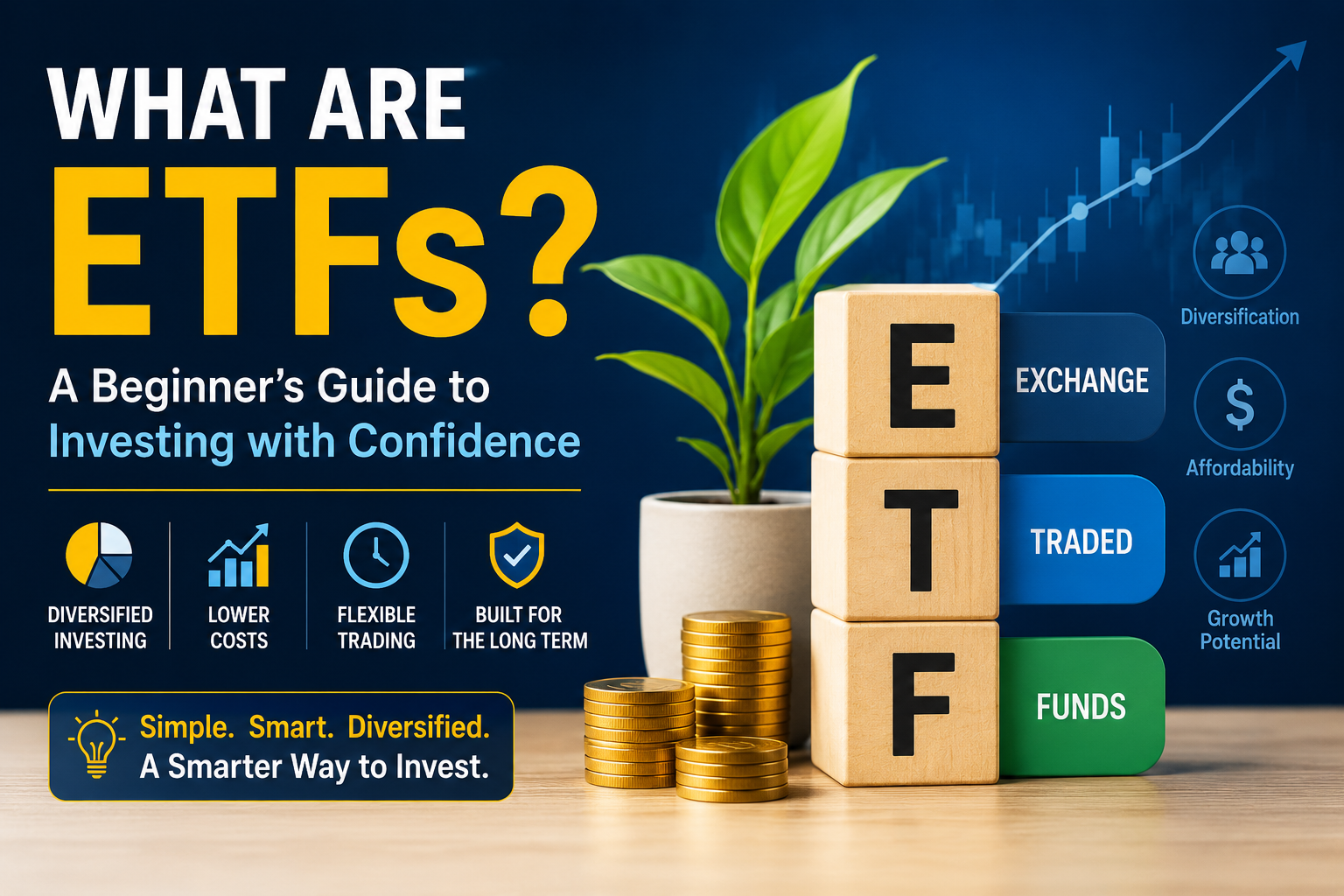
What Are Exchange-Traded Funds (ETFs)? Guide to Investing with Confidence as Investing can feel overwhelming when you’re just getting started. With so many choices—stocks, bonds, mutual funds, and cryptocurrencies—it’s easy to wonder where to begin. One investment option that has become increasingly popular among beginners and experienced investors alike is the Exchange-Traded Fund (ETF).
ETFs offer a simple, affordable, and diversified way to invest in financial markets without having to pick individual stocks. Whether your goal is long-term wealth, retirement planning, or generating passive income, understanding how ETFs work can help you make more informed investment decisions.
How to Start Investing: A Complete Beginner’s Guide to Building Long-Term Wealth
What Is an Exchange-Traded Fund (ETF)?
An Exchange-Traded Fund (ETF) is an investment fund that holds a collection of assets such as stocks, bonds, commodities, or other securities. Instead of buying each investment individually, you purchase a single ETF share that gives you exposure to many different investments at once.
Like individual stocks, ETFs are traded on stock exchanges throughout the trading day. Their prices change as investors buy and sell shares, making them flexible and easy to access.
Quick Answer
An ETF is a basket of investments that trades on a stock exchange like a stock, allowing investors to diversify their portfolios through a single investment.
This makes ETFs one of the simplest investment vehicles for beginners.
How Do ETFs Work?
An ETF is managed by an investment company that selects assets based on the fund’s objective.
For example:
- A U.S. stock market ETF may track hundreds of American companies.
- A global ETF may invest in businesses across multiple countries.
- A bond ETF focuses on government or corporate bonds.
- A gold ETF follows the price of gold.
When you purchase one share of an ETF, you automatically own a small portion of every investment held within that fund.
This structure gives investors broad market exposure without the need to purchase dozens or even hundreds of individual securities.
Why Are ETFs So Popular?
ETFs have grown rapidly because they combine many of the advantages investors look for.
Diversification
One ETF can contain dozens, hundreds, or even thousands of investments. Diversification helps reduce the impact of poor performance from a single company or industry.
Lower Costs
Most ETFs have lower management fees than actively managed mutual funds because many simply track a market index instead of relying on active stock selection.
Easy to Buy and Sell
ETFs trade throughout the day on stock exchanges, allowing investors to buy or sell whenever the market is open.
Transparency
Most ETF providers publish their holdings regularly, so investors know exactly what they own.
Accessibility
Many brokers allow investors to purchase ETFs with relatively small amounts of money, making them accessible to beginners.
Types of Exchange-Traded Funds
Not every ETF is designed for the same purpose. Understanding the major categories helps investors choose funds that align with their goals.
Stock ETFs
These invest in shares of publicly traded companies and are commonly used for long-term growth.
Bond ETFs
Bond ETFs invest in government or corporate debt securities and are often used to generate income or reduce portfolio volatility.
Index ETFs
Index ETFs track market indexes such as broad stock market benchmarks. They are among the most popular choices for long-term investors.
Sector ETFs
Sector ETFs focus on specific industries such as healthcare, technology, finance, or energy.
International ETFs
These funds provide exposure to companies outside an investor’s home country, helping increase global diversification.
Commodity ETFs
Commodity ETFs invest in assets such as gold, silver, oil, or agricultural products.
ETF vs. Mutual Funds
Although ETFs and mutual funds share similarities, they also have important differences.
| Feature | ETFs | Mutual Funds |
|---|---|---|
| Trading | Throughout the day | Once daily |
| Pricing | Changes during market hours | Calculated after market close |
| Fees | Often lower | Can be higher |
| Minimum Investment | Usually low | May require higher minimums |
| Transparency | Frequently updated | Less frequent disclosures |
For many beginners, ETFs provide greater flexibility and lower costs.
Benefits of Investing in ETFs
Investors choose ETFs for many reasons.
1. Instant Diversification
Buying a single ETF can spread your investment across many companies instead of relying on one business.
2. Lower Risk Than Individual Stocks
Although all investments carry risk, diversification can reduce the impact of one company’s poor performance.
3. Cost Efficiency
Lower expense ratios allow investors to keep more of their long-term returns.
4. Long-Term Wealth Building
Many successful investors use ETFs as the foundation of retirement and long-term investment portfolios.
5. Flexibility
There are ETFs designed for income, growth, value investing, sustainability, emerging markets, and many other investment objectives.
Risks of Investing in ETFs
No investment is completely risk-free.
Some common ETF risks include:
- Market downturns can reduce ETF values.
- Sector ETFs may be heavily concentrated in one industry.
- International ETFs can be affected by currency fluctuations and geopolitical events.
- Commodity ETFs may experience significant price volatility.
- Some specialized ETFs have lower trading volumes, making them less liquid.
Understanding these risks helps investors make balanced decisions instead of chasing short-term returns.
How to Start Investing in ETFs
Starting with ETFs is generally straightforward.
Step 1: Define Your Financial Goals
Ask yourself why you’re investing.
Examples include:
- Retirement
- Buying a home
- Building wealth
- Generating passive income
- Funding education
Step 2: Open an Investment Account
Choose a reputable brokerage platform that provides access to ETFs and offers reasonable fees.
Step 3: Research Different ETFs
Compare:
- Investment objective
- Historical performance
- Expense ratio
- Assets under management
- Holdings
- Risk level
Step 4: Invest Regularly
Many investors build wealth through consistent investing instead of trying to predict market movements.
A disciplined approach often delivers better long-term results than attempting to time the market.
Common Mistakes Beginners Should Avoid
Many new investors make avoidable mistakes.
Some of the most common include:
- Investing without understanding the ETF.
- Ignoring management fees.
- Chasing recent high-performing funds.
- Failing to diversify.
- Investing based on emotions instead of a long-term plan.
- Selling during temporary market declines.
Patience and consistency are often more valuable than trying to find the “perfect” investment.
Are ETFs Good for Beginners?
Yes. ETFs are widely considered one of the best investment options for beginners because they offer diversification, relatively low costs, transparency, and simplicity.
Instead of researching dozens of individual companies, investors can gain exposure to an entire market with a single purchase.
That simplicity allows beginners to focus on developing good investing habits while gradually building experience.
UEE Final Thoughts
Exchange-Traded Funds (ETFs) have transformed investing by making diversified portfolios more accessible to everyday investors. Whether you’re saving for retirement, building long-term wealth, or taking your first steps into the financial markets, ETFs provide a practical and flexible way to invest.
Before investing, take time to understand your financial goals, risk tolerance, and investment horizon. Research the funds you’re considering, invest consistently, and remember that successful investing is typically measured over years—not days or weeks. With patience, discipline, and a well-diversified portfolio, ETFs can become a strong foundation for achieving your long-term financial objectives.
Frequently Asked Questions (FAQ)
What is an ETF in simple terms?
An ETF is a fund that holds multiple investments and trades on a stock exchange like an individual stock, giving investors instant diversification through a single purchase.
Are ETFs safer than individual stocks?
ETFs are generally less risky than investing in a single stock because they spread your investment across many assets. However, they still carry market risk and can lose value.
Can beginners invest in ETFs?
Yes. ETFs are widely regarded as beginner-friendly because they are diversified, relatively low-cost, and easy to buy through most brokerage accounts.
How much money do I need to start investing in ETFs?
The amount depends on your brokerage and the ETF’s share price. Some platforms also offer fractional shares, allowing you to begin investing with a relatively small amount.
Do ETFs pay dividends?
Some ETFs distribute dividends earned from the companies or bonds they hold, while others focus primarily on long-term capital growth.
UEE Resources for you.
- Investopedia: Beginner’s Guide to ETFs
- Vanguard: ETF Investing Education Center
- BlackRock iShares: ETF Learning Resources
- Charles Schwab: ETF Investing Guide