Investing in the stock market is one of the most effective ways to build long-term wealth, grow your savings, and work toward financial independence. While many people believe stock investing is only for experienced professionals or wealthy individuals, the reality is that anyone can begin investing with the right knowledge, a clear financial plan, and a long-term mindset.
When you invest in stocks, you’re purchasing shares of ownership in publicly traded companies. As those companies grow and generate profits, the value of your investments may increase over time. Some companies also pay dividends, providing investors with an additional source of income. Although stock prices naturally rise and fall, history has shown that diversified, long-term investing has been a powerful wealth-building strategy for many investors.
If you’re new to the stock market, terms like shares, dividends, exchange-traded funds (ETFs), index funds, brokerage accounts, market capitalization, portfolio diversification, and capital gains can seem overwhelming. Fortunately, you don’t need to master every financial concept before getting started. Learning the fundamentals and following a disciplined investment strategy can help you invest with greater confidence and avoid many of the common mistakes beginners make.
This blog post will explain how the stock market works, the different types of stocks available, how to choose investments that align with your financial goals, and practical steps for building a diversified investment portfolio. You’ll also learn about the risks involved, common investing mistakes to avoid, and strategies that can help you stay focused during changing market conditions.
Whether your goal is to save for retirement, create passive income, achieve financial independence, or simply grow your wealth over time, understanding the basics of stock investing is an important first step. By the end of this guide, you’ll have a solid foundation to make informed investment decisions and begin your journey toward building long-term wealth.
What Is the Stock Market?
The stock market is a marketplace where investors buy and sell shares of publicly traded companies. When you purchase a stock, you become a shareholder, which means you own a small portion of that business. As the company grows and becomes more profitable, the value of your shares may increase. Some companies also distribute a portion of their profits to shareholders through dividend payments.
For individuals looking to build long-term wealth, the stock market provides an opportunity to participate in the growth of businesses across industries such as technology, healthcare, finance, energy, consumer goods, and manufacturing. While stock prices fluctuate daily due to economic conditions, company performance, and investor sentiment, history has shown that diversified, long-term investing has offered strong growth potential over extended periods.
What Is the Purpose of the Stock Market?
The stock market serves two essential functions.
First, it allows companies to raise capital by selling shares to investors. Businesses use this capital to expand operations, develop new products, hire employees, invest in research, and pursue future growth opportunities.
Second, it gives investors the opportunity to build wealth by participating in the success—or failure—of publicly traded companies. Investors may earn returns through rising share prices, dividend income, or a combination of both.
This relationship benefits both companies seeking funding and investors seeking long-term financial growth.
How Does the Stock Market Work?
Stock exchanges provide a regulated environment where buyers and sellers trade shares throughout the trading day.
The price of a stock changes continuously based on supply and demand. When more investors want to buy a stock than sell it, the price generally rises. When more investors want to sell than buy, the price generally falls.
However, short-term price movements don’t always reflect a company’s long-term value. Successful investors often focus on business fundamentals, earnings growth, competitive advantages, and long-term performance rather than reacting to daily market fluctuations.
Why Is the Stock Market Important?
The stock market plays a significant role in the global economy by connecting businesses with investors. It encourages innovation, supports economic growth, creates jobs, and provides individuals with opportunities to grow their wealth over time.
For long-term investors, the stock market can help achieve important financial goals such as:
- Building retirement savings
- Creating passive income through dividends
- Growing investment portfolios
- Funding higher education
- Achieving financial independence
- Preserving purchasing power against inflation
Although investing always involves risk, maintaining a diversified portfolio and staying invested over the long term may help investors navigate periods of market volatility more effectively.
Key Takeaway
The stock market is a regulated marketplace where investors buy and sell ownership shares in publicly traded companies. It enables businesses to raise capital while giving investors the opportunity to grow wealth through capital appreciation and dividend income over the long term.
Frequently Asked Questions
Is the stock market the same as a stock exchange?
No. The stock market refers to the overall system where stocks are bought and sold, while a stock exchange is a specific marketplace that facilitates those trades.
Can beginners invest in the stock market?
Yes. Many beginners start by investing through diversified options such as index funds or ETFs before purchasing individual stocks. Learning the basics and investing consistently can help build confidence over time.
Is investing in the stock market risky?
Yes. Stock prices can rise and fall, and there is no guarantee of profit. However, diversification, a long-term investment horizon, and regular portfolio reviews can help investors manage risk.
- How to Start Investing: A Complete Beginner’s Guide to Building Long-Term Wealth
- What Are ETFs and How Do They Work?
Benefits of Investing in Stocks
Investing in stocks is one of the most effective ways to build wealth over the long term. While no investment is guaranteed to generate positive returns, stocks have historically offered higher growth potential than many traditional savings products over extended periods. For investors with a long-term perspective, stock investing can play a key role in achieving financial goals such as retirement, homeownership, education funding, and financial independence.
Whether you’re investing for the first time or expanding your financial knowledge, understanding the benefits of stock investing can help you make informed decisions and build a strategy that aligns with your goals.
1. Opportunity for Long-Term Wealth Growth
One of the greatest advantages of investing in stocks is the potential for long-term capital appreciation. As successful companies expand their businesses, increase revenue, and generate higher profits, the value of their shares may increase over time.
Instead of allowing your money to remain idle, investing gives your savings the opportunity to grow alongside businesses operating in sectors such as technology, healthcare, finance, consumer goods, and energy.
Although markets experience short-term ups and downs, patient investors who maintain diversified portfolios often focus on long-term growth rather than daily price movements.
2. Earn Passive Income Through Dividends
Many established companies reward shareholders by paying dividends, which are regular distributions of a portion of company profits.
Dividend investing offers several advantages:
- Provides an additional income stream.
- Can be reinvested to purchase more shares.
- Supports long-term portfolio growth through compounding.
- May provide greater stability during periods of market volatility.
Over many years, reinvesting dividends can significantly increase the overall value of an investment portfolio.
3. Benefit from the Power of Compound Growth
Compound growth is one of the most powerful concepts in investing.
When you reinvest dividends and investment gains, your earnings begin generating additional earnings over time. Instead of growing only your original investment, your portfolio grows on both your initial capital and accumulated returns.
The earlier you begin investing and the longer you remain invested, the greater the potential impact of compounding on your financial future.
4. Help Protect Your Money from Inflation
Inflation gradually reduces the purchasing power of money. If your savings earn less than the rate of inflation, your money may buy fewer goods and services in the future.
While stock investments can fluctuate in value, many investors use them as part of a long-term strategy aimed at preserving and growing purchasing power over time.
Investing in quality businesses that continue to innovate and grow may help offset the long-term effects of inflation.
5. Build a Diversified Investment Portfolio
Stocks can form the foundation of a diversified investment portfolio.
Investors can spread risk by owning companies across different industries, countries, and market sectors or by investing in diversified products such as index funds and Exchange-Traded Funds (ETFs).
Diversification helps reduce the impact that poor performance from any single company or sector may have on your overall portfolio.
6. Flexibility to Match Your Financial Goals
The stock market offers investment opportunities suitable for different objectives and risk tolerances.
For example, investors may choose:
- Growth stocks for long-term capital appreciation.
- Dividend stocks for regular income.
- Index funds for broad market exposure.
- ETFs for diversification.
- Blue-chip stocks for established companies with strong track records.
This flexibility allows investors to create a portfolio that reflects their personal financial goals and investment timeline.
Key Takeaway
Investing in stocks offers the potential to grow wealth, generate passive income, benefit from compound growth, and work toward long-term financial goals. While stock investing involves risk, maintaining a diversified portfolio and investing consistently over time can help investors build financial security and participate in the growth of the global economy.
Frequently Asked Questions
Why do people invest in stocks?
People invest in stocks to build long-term wealth, generate dividend income, save for retirement, achieve financial independence, and potentially grow their money faster than inflation over time.
Are stocks a good investment for beginners?
Stocks can be suitable for beginners, especially when approached with a long-term mindset. Many new investors start with diversified investments such as index funds or ETFs before selecting individual companies.
Can investing in stocks make you rich?
Investing in stocks has helped many people build significant wealth over time, but there are no guarantees. Success depends on factors such as consistent investing, diversification, patience, and making informed decisions while understanding the risks involved.
Different Types of Stocks Every Investor Should Know
One of the first steps toward becoming a confident investor is understanding the different types of stocks available in the market. Not all stocks behave the same way. Some companies focus on rapid growth, while others prioritize paying regular dividends to shareholders. Understanding these differences can help you build a diversified portfolio that aligns with your financial goals, investment timeline, and tolerance for risk.
Whether you’re investing for retirement, passive income, or long-term wealth creation, knowing the characteristics of each stock category will help you make more informed investment decisions.
1. Growth Stocks
Growth stocks are shares of companies expected to increase their revenue and earnings faster than the overall market. These businesses often reinvest profits into expansion, research, innovation, and new products instead of paying dividends.
Growth stocks may offer significant long-term capital appreciation, but they can also experience greater price volatility. Investors with a longer investment horizon often include growth stocks as part of their portfolio because of their potential for future returns.
2. Value Stocks
Value stocks are companies that appear to trade below what many investors believe is their intrinsic value. They may become undervalued due to temporary market conditions, economic uncertainty, or short-term challenges.
Many long-term investors seek value stocks with strong financial fundamentals, believing the market may eventually recognize their true worth. While no investment is guaranteed, value investing focuses on purchasing quality businesses at reasonable prices.
3. Dividend Stocks
Dividend stocks belong to companies that regularly distribute a portion of their profits to shareholders through dividend payments.
These stocks are popular among investors seeking:
- Passive income
- Long-term portfolio stability
- Reinvestment opportunities
- Retirement income
Reinvesting dividends can contribute to compound growth, helping your investment portfolio increase in value over many years.
4. Blue-Chip Stocks
Blue-chip stocks represent large, well-established companies with long operating histories and strong financial positions.
These businesses often have recognizable brands, experienced management teams, and a record of consistent performance across different economic conditions.
Although blue-chip stocks are not immune to market risk, many investors consider them important building blocks of a diversified portfolio because they may offer stability and long-term growth potential.
5. Income Stocks
Income stocks are purchased primarily for the regular cash payments they generate rather than rapid price appreciation.
Many mature companies with stable earnings distribute consistent dividends, making income stocks attractive for investors who value predictable cash flow.
These investments may be particularly appealing for retirees or individuals seeking additional investment income.
6. Small-Cap, Mid-Cap, and Large-Cap Stocks
Stocks are also classified according to market capitalization, which refers to the total market value of a company’s outstanding shares.
- Large-cap stocks are generally established companies with substantial market value and stable business operations.
- Mid-cap stocks often represent businesses that continue to expand and may offer a balance between growth potential and stability.
- Small-cap stocks are typically younger or smaller companies with greater growth potential but also higher levels of investment risk.
Each category plays a different role in portfolio diversification.
Which Type of Stock Is Best?
There is no single type of stock that is best for every investor. The right choice depends on your financial objectives, investment horizon, and personal risk tolerance.
Many experienced investors build diversified portfolios by combining several stock categories instead of relying on one type alone. This approach helps balance growth opportunities with income generation and risk management.
Key Takeaway
Understanding the different types of stocks—including growth, value, dividend, blue-chip, income, and market-cap categories—can help you build a diversified investment portfolio that supports your long-term financial goals. Rather than focusing on one category, many successful investors spread their investments across multiple types of stocks to reduce risk and improve long-term growth potential.
Frequently Asked Questions
What type of stock is best for beginners?
Many beginners start with diversified investments such as index funds or ETFs. Those who invest in individual stocks often begin with financially strong, established companies while continuing to diversify their portfolios.
What is the difference between growth stocks and dividend stocks?
Growth stocks typically reinvest profits to expand the business and aim for long-term price appreciation. Dividend stocks regularly distribute a portion of company profits to shareholders as dividend payments, providing an income stream in addition to potential share price growth.
Should I invest in only one type of stock?
Generally, concentrating all of your investments in a single stock category increases risk. A diversified portfolio that includes different types of stocks and other asset classes can help reduce overall investment risk while supporting long-term financial objectives.
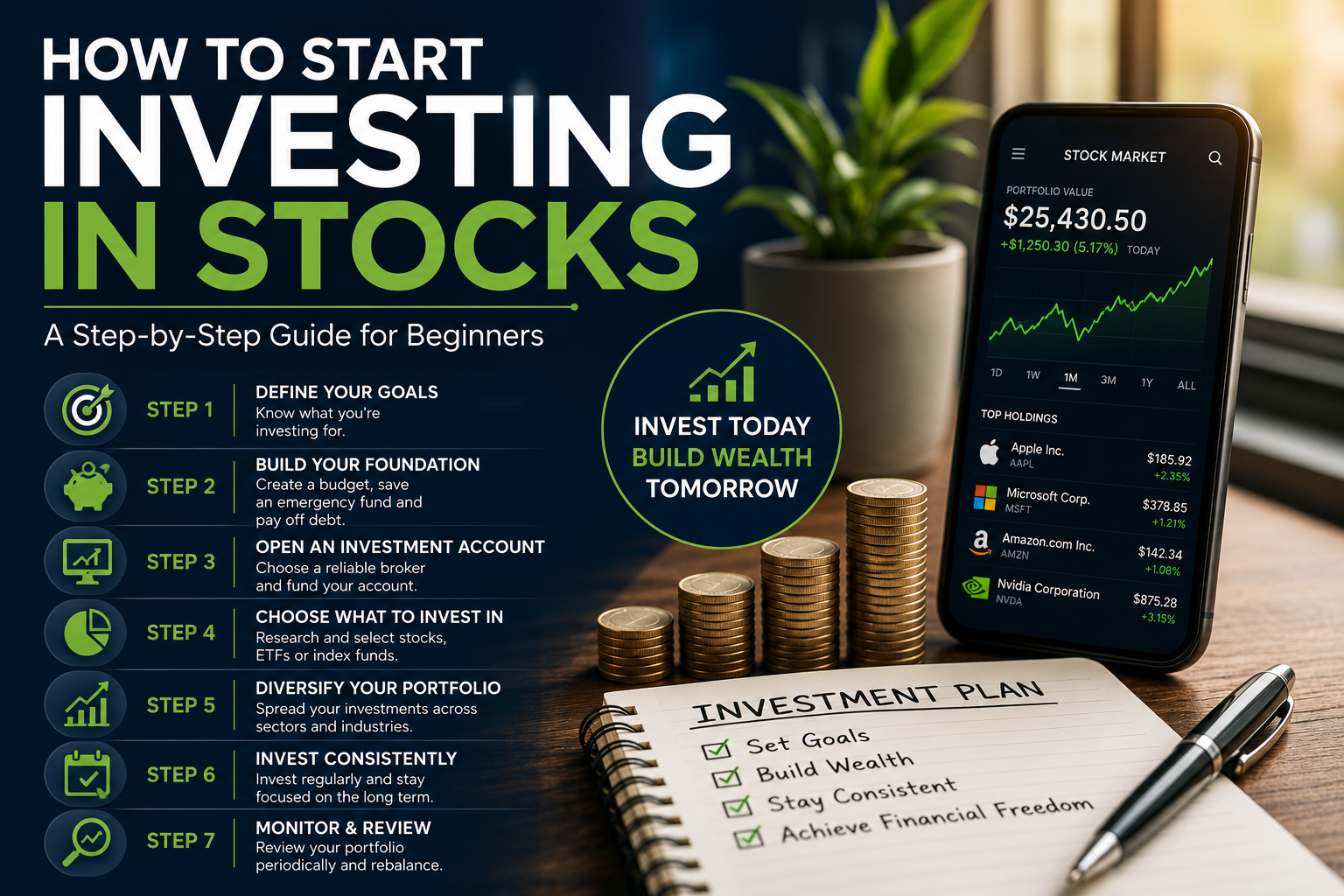
How to Start Investing in Stocks Step by Step
Starting your stock investing journey doesn’t have to be complicated. While the financial markets may seem intimidating at first, successful investing is built on a few simple principles: setting clear goals, choosing the right investment account, diversifying your portfolio, and staying invested for the long term. Rather than trying to predict short-term market movements, focus on creating a disciplined investment strategy that you can maintain through changing market conditions.
The following steps provide a practical roadmap for beginners looking to invest in stocks with confidence.
Step 1: Define Your Investment Goals
Before purchasing your first stock, ask yourself why you’re investing.
Your financial goals will influence every investment decision you make.
Common goals include:
- Building long-term wealth
- Saving for retirement
- Creating passive income
- Buying a home
- Funding higher education
- Achieving financial independence
Having a clearly defined objective makes it easier to choose investments that match your timeline and tolerance for risk.
Step 2: Build a Strong Financial Foundation
Investing should be part of a broader financial plan.
Before investing significant amounts, consider whether you have:
- A realistic monthly budget
- An emergency savings fund
- Manageable high-interest debt
- Adequate insurance coverage
- Consistent monthly income
A solid financial foundation reduces the likelihood of needing to sell investments during unexpected financial emergencies.
Step 3: Choose the Right Investment Account
To buy stocks, you’ll typically need to open an investment account with a licensed brokerage firm or investment platform.
When comparing providers, consider:
- Account fees
- Investment choices
- Educational resources
- Research tools
- Customer support
- Security features
- Ease of use
Choose a provider that is properly regulated in your country and offers investment products that align with your financial goals.
Step 4: Decide What to Invest In
One of the biggest mistakes beginners make is investing in companies they know very little about.
Instead, take time to understand different investment options such as:
- Individual stocks
- Index funds
- Exchange-Traded Funds (ETFs)
- Mutual funds
- Dividend-paying companies
Many first-time investors begin with diversified investments because they spread risk across many companies rather than relying on the performance of a single business.
Step 5: Diversify Your Portfolio
Diversification is one of the most effective ways to manage investment risk.
Rather than concentrating your money in one company or industry, consider spreading investments across different sectors and asset classes.
A diversified portfolio may include companies from industries such as:
- Technology
- Healthcare
- Financial services
- Consumer goods
- Energy
- Manufacturing
Diversification cannot eliminate risk, but it can reduce the impact of poor performance from individual investments.
Step 6: Invest Consistently
Successful investing is often about consistency rather than timing.
Many investors contribute a fixed amount regularly instead of waiting for the “perfect” time to invest.
Consistent investing offers several advantages:
- Encourages financial discipline.
- Builds wealth gradually.
- Reduces emotional decision-making.
- Supports long-term investment habits.
Over time, regular investing can help you take advantage of compound growth and market appreciation.
Step 7: Monitor Your Investments Without Overreacting
Once you’ve built your portfolio, avoid checking prices every day.
Daily market fluctuations are normal and should be expected.
Instead, review your portfolio periodically to determine whether it still aligns with your financial goals and desired level of risk.
Avoid making investment decisions based solely on headlines, market rumors, or social media trends.
Key Takeaway
Starting to invest in stocks begins with setting clear financial goals, building a strong financial foundation, choosing a reputable investment account, diversifying your portfolio, and investing consistently over the long term. While market prices fluctuate, maintaining a disciplined strategy and focusing on your long-term objectives can help you become a more confident investor.
Frequently Asked Questions
How much money do I need to start investing in stocks?
The minimum amount depends on your brokerage or investment platform. Many providers now allow investors to begin with relatively small amounts. What’s most important is investing consistently and within your financial means.
Should beginners buy individual stocks or diversified funds?
Many beginners start with diversified investments, such as index funds or ETFs, because they provide exposure to multiple companies in a single investment. Individual stocks may require more research and carry greater company-specific risk.
How often should I invest?
Many long-term investors choose to invest regularly—such as monthly or with each paycheck—because consistency can help build disciplined investing habits over time. The best schedule depends on your income, budget, and financial goals.
Suggested External Resources
IF you want to learn more, consider linking to these trusted resources:
- U.S. Securities and Exchange Commission – Investor education on stocks, risks, and fraud prevention.
- Investor.gov – Beginner-friendly guides, investment calculators, and financial education.
- Financial Industry Regulatory Authority – Resources on brokerage accounts, investing basics, and investor protection.
- CFA Institute – Educational articles on investing, portfolio management, and financial markets.