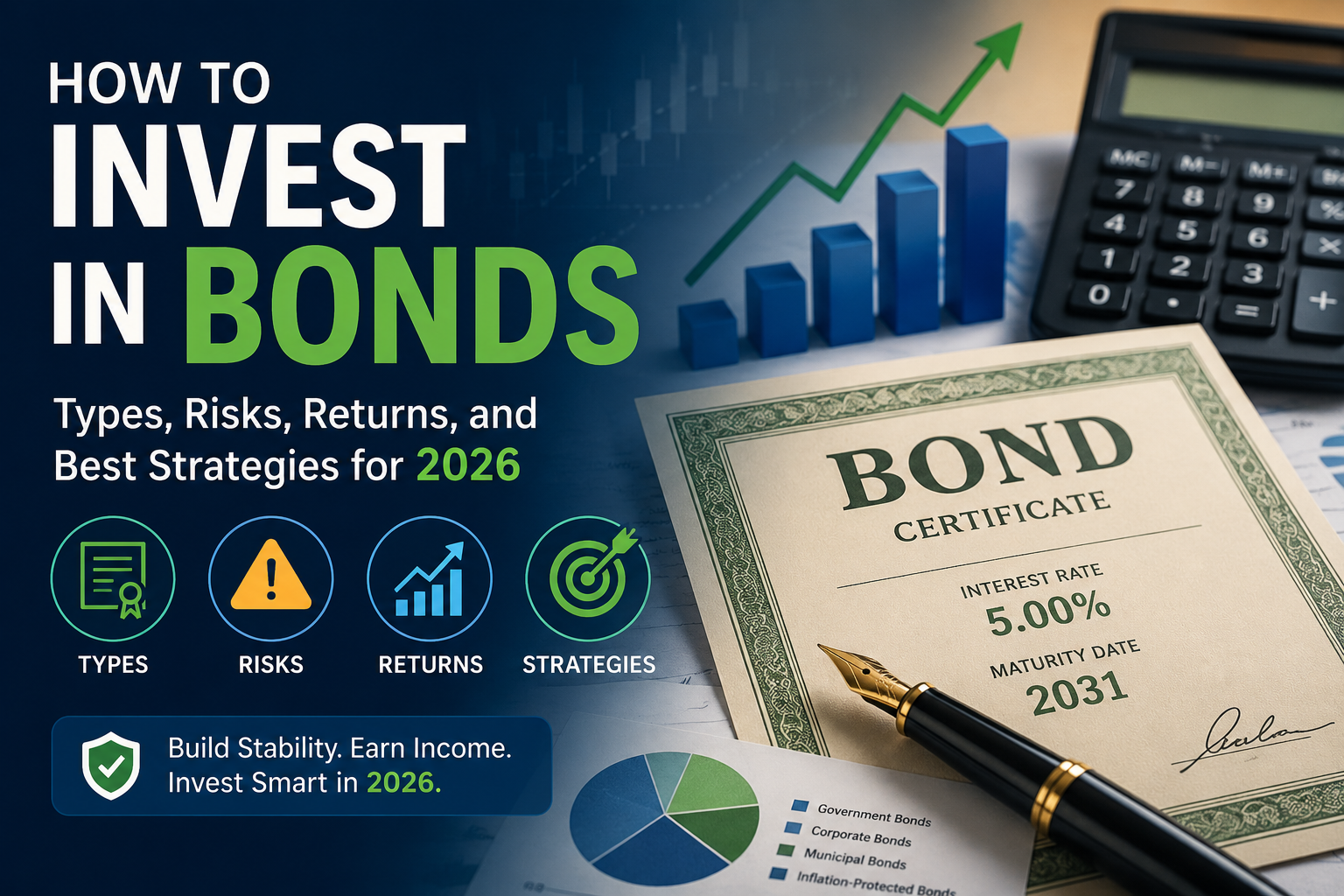
How to Invest in Bonds, Types, Risks, Returns, and Best Strategies for 2026 as investing in bonds has long been one of the most reliable ways to build wealth, generate steady income, and reduce portfolio volatility. Whether you’re saving for retirement, looking to diversify your investments, or seeking a lower-risk alternative to stocks, bonds can play an important role in your financial strategy.
In 2026, rising interest rate expectations, changing economic conditions, and global market uncertainty make understanding bond investing more important than ever. This guide explains how bonds work, the different types available, their risks and returns, and practical strategies to help investors make informed decisions.
Beginner’s Guide to Investing in Stocks
How Diversification Reduces Investment Risk
What Is a Bond?
A bond is a fixed-income investment where an investor lends money to a government, corporation, or other organization in exchange for regular interest payments and the return of the original investment (principal) at maturity.
Quick Answer
A bond is a loan made by an investor to a government or company. In return, the borrower pays regular interest and repays the original investment when the bond reaches maturity.
Unlike stocks, bonds do not provide ownership in a company. Instead, they represent debt obligations.
How Do Bonds Work?
Every bond includes several key components:
- Face Value: The amount repaid at maturity.
- Coupon Rate: The annual interest rate paid to investors.
- Maturity Date: The date when the principal is returned.
- Issuer: The government or company borrowing the money.
For example:
You purchase a $1,000 bond paying 5% annual interest for 10 years.
You receive:
- $50 annually in interest.
- $1,000 returned after 10 years.
Types of Bonds
Understanding the different types of bonds helps investors choose investments that align with their financial goals.
Government Bonds
Government bonds are issued by national governments and are generally considered among the safest investments.
Benefits include:
- High credit quality
- Reliable interest payments
- Lower investment risk
They are commonly used by conservative investors seeking capital preservation.
Corporate Bonds
Companies issue corporate bonds to raise capital for business operations or expansion.
Advantages include:
- Higher yields than government bonds
- Wide range of investment options
- Income generation
However, corporate bonds usually carry greater credit risk because companies can experience financial difficulties.
Municipal Bonds
Municipal bonds are issued by local or regional governments to finance public infrastructure projects.
Many municipal bonds offer tax advantages depending on local regulations, making them attractive to higher-income investors.
Treasury Inflation-Protected Bonds
These bonds adjust their principal based on inflation.
Benefits include:
- Protection against rising prices
- Stable purchasing power
- Lower inflation risk
High-Yield Bonds
Also known as “junk bonds,” these offer higher interest rates because they are issued by companies with lower credit ratings.
Potential rewards are greater, but so is the possibility of default.
Benefits of Investing in Bonds
Bonds remain a valuable part of diversified investment portfolios for several reasons.
Regular Income
Most bonds pay predictable interest, making them ideal for investors seeking consistent cash flow.
Lower Portfolio Volatility
Bond prices generally fluctuate less than stocks, helping reduce overall investment risk.
Capital Preservation
High-quality bonds are often used to preserve wealth while generating modest returns.
Portfolio Diversification
Holding both stocks and bonds can reduce overall portfolio volatility because the two asset classes often react differently to market conditions.
Risks of Bond Investing
Although bonds are generally considered safer than stocks, they are not risk-free.
Interest Rate Risk
When interest rates rise, existing bond prices usually fall.
Long-term bonds are especially sensitive to changing interest rates.
Credit Risk
The issuer may fail to make interest payments or repay the principal.
Checking credit ratings before investing can help reduce this risk.
Inflation Risk
Inflation reduces the purchasing power of future bond payments.
Inflation-protected bonds help address this concern.
Liquidity Risk
Some bonds can be difficult to sell before maturity without accepting a lower price.
What Returns Can Investors Expect?
Bond returns depend on several factors:
- Interest rates
- Credit quality
- Time to maturity
- Market conditions
Historically, government bonds have produced lower but more stable returns than stocks.
Corporate and high-yield bonds typically provide higher returns but involve greater risk.
Instead of chasing the highest yield, investors should focus on balancing income with acceptable risk.
Best Bond Investment Strategies for 2026
1. Diversify Across Bond Types
Avoid concentrating investments in a single issuer or bond category.
Consider combining:
- Government bonds
- Corporate bonds
- Municipal bonds
- Inflation-protected bonds
Diversification helps reduce risk.
2. Build a Bond Ladder
A bond ladder involves purchasing bonds with different maturity dates.
Example:
- 2-year bond
- 5-year bond
- 7-year bond
- 10-year bond
As each bond matures, investors can reinvest at current interest rates.
This strategy reduces interest rate risk.
3. Focus on High-Quality Issuers
For conservative investors, prioritizing investment-grade bonds can help preserve capital while providing dependable income.
4. Consider Bond ETFs and Mutual Funds
Buying individual bonds requires research and larger investments.
Bond funds provide:
- Instant diversification
- Professional management
- Easy buying and selling
These are suitable for beginners.
5. Match Bond Duration to Financial Goals
Short-term bonds generally offer:
- Lower price volatility
- Faster access to capital
Long-term bonds may provide:
- Higher yields
- Greater sensitivity to interest rate changes
Choose durations that align with your investment timeline.
Should Beginners Invest in Bonds?
Yes.
Bonds are often recommended for beginners because they offer predictable income and typically lower risk than stocks.
New investors may start with diversified bond ETFs before purchasing individual bonds.
A balanced portfolio containing both stocks and bonds is commonly used to pursue long-term growth while managing risk.
Tips for Choosing the Right Bonds
Before investing, ask yourself:
- What is my investment objective?
- How much risk can I tolerate?
- When will I need my money?
- Do I need regular income?
- Am I investing for growth or stability?
Answering these questions can help you select bonds that fit your financial plan.
Conclusion
Bonds remain one of the most dependable investment options in 2026 for investors seeking stability, predictable income, and portfolio diversification. While no investment is completely risk-free, understanding bond types, evaluating potential risks, and using proven strategies such as diversification and bond laddering can improve long-term outcomes.
Whether you invest in government bonds, corporate bonds, municipal bonds, or diversified bond funds, the key is aligning your investments with your financial goals and risk tolerance. By taking a disciplined, long-term approach, bonds can provide a solid foundation for a well-balanced investment portfolio.
Frequently Asked Questions (FAQ)
What is the safest type of bond?
Government bonds issued by financially stable countries are generally considered the safest because they have a lower risk of default.
Can you lose money investing in bonds?
Yes. Bond prices can decline due to rising interest rates, issuer defaults, inflation, or if you sell before maturity at a lower price.
Are bonds better than stocks?
Neither is inherently better. Bonds typically offer lower risk and more predictable income, while stocks have greater long-term growth potential but higher volatility.
How much should a beginner invest in bonds?
The amount depends on your financial goals, age, and risk tolerance. Many investors allocate a portion of their portfolio to bonds as part of a diversified investment strategy.
Is 2026 a good time to invest in bonds?
Bond opportunities in 2026 depend on interest rates, inflation, and broader economic conditions. Investors should evaluate current market conditions and ensure their bond investments align with their long-term objectives.
UEE Resources
- U.S. Securities and Exchange Commission (SEC) – Learn about bond investing and investor protection.
- Financial Industry Regulatory Authority (FINRA) – Bond education, pricing tools, and market insights.
- Investopedia – In-depth guides on bond types, yields, and fixed-income investing.
- Morningstar – Independent research and analysis of bond funds and fixed-income investments.