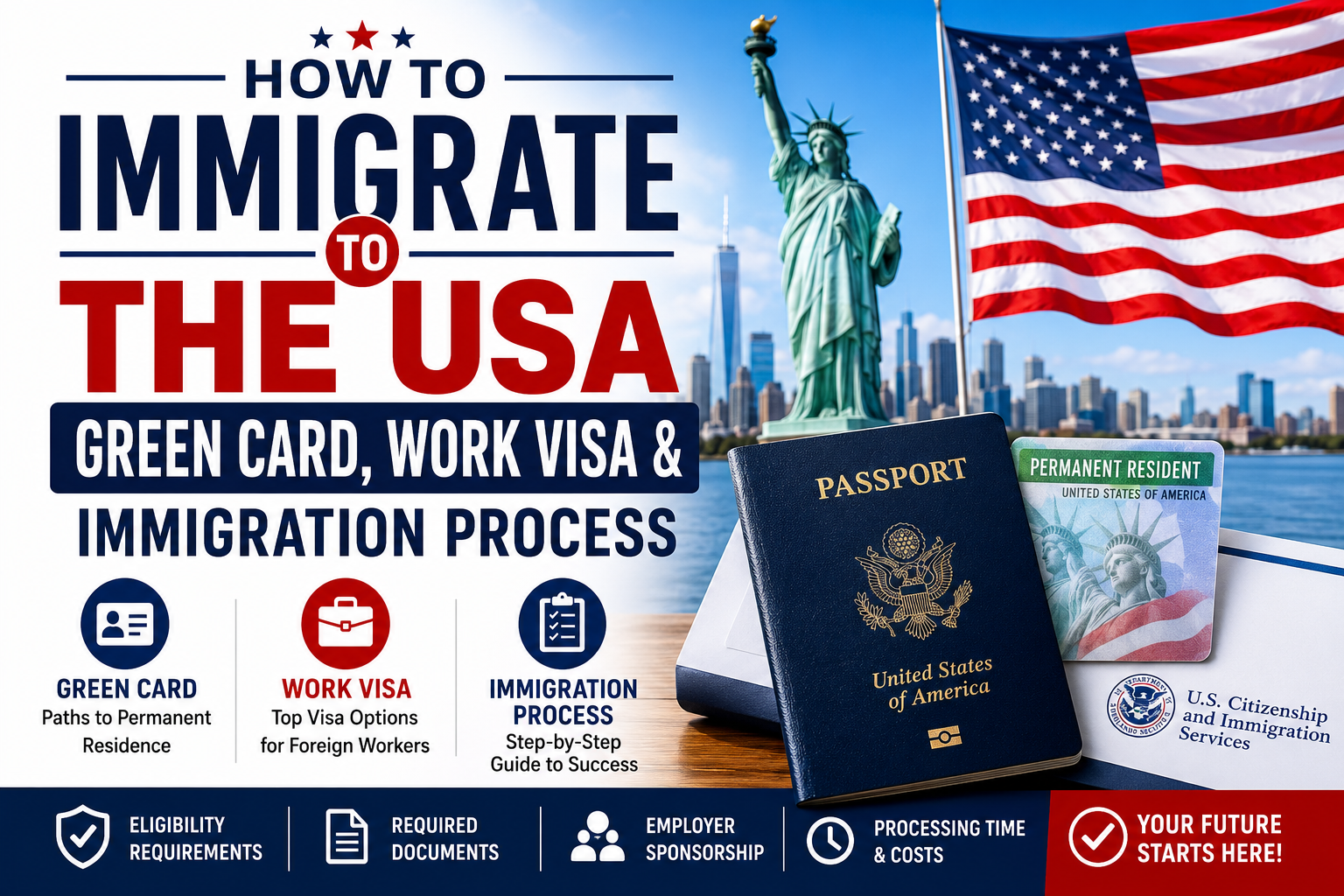
How to Immigrate to the USA: Green Card, Work Visa & Immigration Process. WhileThe United States remains one of the world’s most sought-after destinations for immigrants looking to build a career, reunite with family, start a business, or pursue long-term opportunities. Every year, millions of people apply for U.S. visas and lawful permanent residence (Green Cards) through employment, family sponsorship, investment, humanitarian programs, and the Diversity Visa Lottery.
If you’re considering moving to the United States, understanding the immigration process before applying can save time, reduce costly mistakes, and improve your chances of success. This guide explains the primary immigration pathways, Green Card eligibility, work visa options, required documents, and important considerations for prospective immigrants.
Suggestion: Canada Immigration Requirements: Eligibility, Visa Options & Application Process
Suggestion: Australia Immigration Requirements for Foreign Workers in 2026
Whether your goal is permanent residency, employment, or family reunification, every application is reviewed individually by U.S. immigration authorities. Preparing complete documentation and choosing the correct immigration pathway are essential first steps.
How U.S. Immigration Works
The most common ways to immigrate to the United States include:
- Employment-based immigration
- Family-sponsored immigration
- Diversity Visa (DV) Lottery
- Investment immigration
- Humanitarian programs
- Special immigrant categories
Many applicants begin with a temporary visa before becoming eligible for permanent residence (Green Card), while others qualify to apply directly for immigrant visas.
U.S. Immigration Eligibility Checker
Before applying, consider the following checklist.
✔ Valid passport
✔ Meet the eligibility requirements for your chosen visa
✔ Financial ability where required
✔ No serious immigration violations
✔ No criminal inadmissibility issues (subject to applicable laws)
✔ Supporting documentation available
✔ Genuine purpose for immigration
✔ Meet health and security screening requirements
Eligibility requirements vary depending on the immigration category selected.
What Is a Green Card?
A Green Card, officially known as a Permanent Resident Card, allows eligible foreign nationals to live and work permanently in the United States.
Green Card holders generally can:
- Live permanently in the U.S.
- Work for most employers
- Own property
- Attend schools and universities
- Travel internationally, subject to immigration rules
- Eventually apply for U.S. citizenship if eligible
Permanent residence is one of the most common long-term immigration goals.
Major Ways to Immigrate to the USA
Employment-Based Immigration
Many professionals immigrate through employer sponsorship.
Popular employment-based pathways include:
- EB-1
- EB-2
- EB-3
- EB-4
- EB-5 Investor Program
Some employment-based categories require labor certification, while others may qualify for exemptions depending on the applicant’s qualifications.
Family-Sponsored Immigration
U.S. citizens and lawful permanent residents may sponsor certain eligible relatives for permanent residence.
Eligible family relationships vary based on the sponsor’s immigration status and applicable U.S. immigration law.
Diversity Visa Lottery
The Diversity Immigrant Visa Program offers eligible applicants from qualifying countries the opportunity to apply for permanent residence through an annual lottery program.
Selection does not guarantee approval. Applicants must still satisfy all eligibility requirements.
Investment Immigration
The EB-5 Immigrant Investor Program allows eligible investors who meet investment and job creation requirements to pursue permanent residence.
Investment requirements are established by U.S. immigration law and may change periodically.
Humanitarian Programs
Certain individuals may qualify through humanitarian pathways, including refugee or asylum protections where applicable under U.S. law.
Employment-Based Green Card Categories
EB-1
Designed primarily for individuals with extraordinary ability, outstanding professors and researchers, and certain multinational executives.
EB-2
Generally intended for professionals holding advanced degrees or individuals with exceptional ability.
Some applicants may qualify for a National Interest Waiver (NIW).
EB-3
Commonly used by:
- Skilled workers
- Professionals
- Certain other qualified workers
Many international workers begin their U.S. immigration journey through this category.
EB-5
For eligible investors who satisfy investment and employment creation requirements established under federal law.
Temporary Work Visa Options
Many individuals first enter the United States using temporary employment visas before pursuing permanent residence.
Popular work visas include:
- H-1B
- L-1
- O-1
- TN
- E-2 (where applicable)
- H-2A
- H-2B
Each visa category has unique eligibility requirements, employer obligations, and validity periods.
Documents Commonly Required
Applicants should prepare documentation appropriate to their immigration category.
Common documents include:
Identity Documents
- Valid passport
- Birth certificate
- Passport photographs
Employment Documents
- Employment offer
- Educational credentials
- Professional licenses
- Resume or CV
- Employment verification letters
Financial Documents
- Bank statements
- Tax returns where applicable
- Investment records for investor programs
Civil Documents
- Marriage certificate
- Divorce certificate (if applicable)
- Police certificates
- Court records (if requested)
Additional documentation may be required depending on the immigration category.
Estimated Salary by Occupation
| Occupation | Typical U.S. Salary Range (Annual) |
|---|---|
| Software Engineer | $90,000–$170,000 |
| Registered Nurse | $70,000–$130,000 |
| Civil Engineer | $80,000–$140,000 |
| Accountant | $65,000–$120,000 |
| Electrician | $60,000–$100,000 |
| Data Analyst | $75,000–$130,000 |
| Cybersecurity Analyst | $95,000–$170,000 |
| Physician | $180,000–$350,000+ |
| Pharmacist | $110,000–$160,000 |
| Construction Manager | $90,000–$160,000 |
Actual salaries vary by employer, experience, education, location, and market conditions.
States Compared for New Immigrants
| State | Major Industries | Cost of Living | Job Opportunities |
|---|---|---|---|
| California | Technology, Healthcare, Entertainment | High | Excellent |
| Texas | Energy, Technology, Manufacturing | Moderate | Excellent |
| Florida | Tourism, Healthcare, Finance | Moderate | Strong |
| New York | Finance, Healthcare, Technology | High | Excellent |
| North Carolina | Manufacturing, Technology | Moderate | Growing |
| Georgia | Logistics, Technology | Moderate | Growing |
| Washington | Technology, Aerospace | High | Excellent |
| Arizona | Manufacturing, Healthcare | Moderate | Strong |
Choosing the right state depends on your profession, budget, family needs, and employment opportunities.
High-Demand Occupations
Many employment-based immigrants work in sectors experiencing ongoing labor shortages.
| Occupation | Demand |
|---|---|
| Registered Nurse | Very High |
| Physician | Very High |
| Software Developer | Very High |
| AI Engineer | Very High |
| Cybersecurity Specialist | Very High |
| Electrician | High |
| Welder | High |
| Truck Driver | High |
| Construction Manager | High |
| Accountant | High |
These occupations frequently appear in employer recruitment efforts, though hiring needs vary over time.
How to Immigrate to the USA: Green Card, Work Visa & Immigration Process
Step-by-Step U.S. Immigration Process
Whether you’re applying through employment, family sponsorship, or another immigration category, understanding the process can help you prepare a stronger application.
Step 1: Choose the Correct Immigration Pathway
Start by identifying the immigration category that matches your circumstances.
The most common options include:
- Employment-based Green Card
- Family-sponsored immigration
- Diversity Visa Lottery
- Investor immigration
- Temporary work visa
- Humanitarian programs
Choosing the wrong category can result in delays or application refusal.
Step 2: Confirm Your Eligibility
Review the official eligibility requirements before submitting an application.
Important factors include:
- Education
- Employment history
- Financial capability
- Family relationship (where applicable)
- Employer sponsorship
- Immigration history
Step 3: Gather Required Documents
Prepare all supporting documents before filing your application.
Typical documents include:
- Passport
- Birth certificate
- Educational qualifications
- Employment verification
- Police certificates (where required)
- Medical examination (if applicable)
- Financial documentation
- Marriage certificate (if applicable)
Submitting complete documentation helps reduce processing delays.
Step 4: Employer Sponsorship (Employment-Based Applicants)
Many employment-based Green Card applicants require a U.S. employer willing to sponsor them.
The employer may need to complete several immigration steps before you become eligible for permanent residence.
Not every work visa automatically leads to a Green Card, although many professionals eventually transition to permanent residence.
Major U.S. Employers That Frequently Hire International Talent
Large employers regularly recruit skilled professionals from around the world.
Examples include:
- Amazon
- Microsoft
- Apple
- Meta
- JPMorgan Chase
- Deloitte
- Accenture
- Oracle
- IBM
- Intel
- Tesla
- Boeing
- Cisco
- NVIDIA
Employment opportunities depend on your qualifications, available positions, and immigration sponsorship policies.
Industries with Strong Hiring Demand
International professionals often find opportunities in:
Technology
Popular positions include:
- Software Engineer
- Cloud Engineer
- AI Engineer
- Cybersecurity Analyst
- Data Scientist
Healthcare
Common occupations include:
- Registered Nurse
- Physician
- Pharmacist
- Physical Therapist
- Medical Laboratory Scientist
Engineering
High-demand specialties include:
- Civil Engineering
- Mechanical Engineering
- Electrical Engineering
- Petroleum Engineering
Skilled Trades
Many employers also recruit:
- Welders
- Electricians
- HVAC Technicians
- Industrial Mechanics
- Heavy Equipment Operators
Estimated Processing Times
Processing timelines vary considerably depending on:
- Immigration category
- Country of birth
- Visa availability
- Government workload
- Security screening
- Background verification
Employment-based Green Cards often take longer than temporary work visas, while family-sponsored cases depend on visa availability and relationship category.
Applicants should always check the latest processing estimates published by U.S. Citizenship and Immigration Services (USCIS) and the U.S. Department of State.
Common Reasons Applications Are Delayed or Denied
Although many applications are approved every year, delays can occur for several reasons.
Incomplete Documentation
Missing documents remain one of the leading causes of delays.
Incorrect Information
Inconsistent dates, employment history, or identity information may trigger additional review.
Failure to Meet Eligibility Requirements
Every immigration category has specific requirements.
Applicants must satisfy all applicable criteria.
Medical or Security Concerns
Certain health or security issues may affect admissibility under U.S. immigration law.
Insufficient Supporting Evidence
Applications supported by clear and organized documentation are generally easier for immigration officers to review.
Tips to Improve Your Immigration Application
Although approval can never be guaranteed, these best practices may strengthen your application.
Choose the Right Immigration Category
Selecting the appropriate pathway is one of the most important decisions.
Keep Accurate Records
Maintain copies of:
- Employment letters
- Educational certificates
- Tax documents
- Travel records
- Immigration correspondence
Submit Complete Documentation
Double-check every required document before filing.
Be Truthful
Providing false or misleading information can result in refusal and long-term immigration consequences.
Respond Quickly to Government Requests
If immigration authorities request additional evidence, respond within the specified timeframe.
Expandable Section: Which Immigration Path Is Right for You?
Employment-Based Immigration
Best for professionals with skills, qualifications, or employer sponsorship.
Family-Based Immigration
Ideal if you have qualifying family members who are U.S. citizens or lawful permanent residents.
Diversity Visa Lottery
Suitable for applicants born in eligible countries who meet educational or work experience requirements.
Investor Immigration
Designed for individuals able to make qualifying investments under the EB-5 program.
Recent U.S. Immigration Information
U.S. immigration policies, visa availability, filing procedures, and processing priorities may change periodically due to legislative updates, executive actions, or administrative policy revisions.
Applicants should regularly review:
- USCIS announcements
- Department of State Visa Bulletin
- Official filing instructions
- Processing time updates
- Fee changes
- Immigration policy updates
Always rely on official government sources for the latest information before submitting your application.
Frequently Asked Questions
What is the fastest way to immigrate to the USA?
The fastest option depends on your individual circumstances. Some employment, family, and temporary visa pathways may process more quickly than others, but processing times vary.
Can I get a Green Card without a job offer?
Yes. Certain immigration categories, including family-sponsored immigration, the Diversity Visa Lottery, some humanitarian programs, and some employment-based exceptions, do not require a traditional employer job offer.
Is a Green Card the same as U.S. citizenship?
No. A Green Card grants lawful permanent residence. Eligible permanent residents may later apply for U.S. citizenship through naturalization if they meet the applicable requirements.
How much money do I need to immigrate to the USA?
There is no single minimum amount. Financial requirements depend on the immigration category, sponsorship arrangements, and individual circumstances.
Can my family immigrate with me?
Many immigration categories allow eligible spouses and dependent children to accompany or later join the principal applicant, subject to U.S. immigration laws.
Do I need an immigration lawyer?
Many applicants complete the process independently, while others choose professional legal assistance for complex cases.
Continue to Part 3 for:
- Detailed Green Card categories
- Family sponsorship explained
- Diversity Visa Lottery
- Investor immigration
- Official resources
- Additional FAQs
- Related articles
- Disclaimer
- EEAT enhancements
- High-CPC content optimization
How to Immigrate to the USA: Green Card, Work Visa & Immigration Process
Understanding Green Card Categories
Obtaining lawful permanent residence (a Green Card) is one of the primary goals for many immigrants. The United States offers several Green Card pathways depending on your qualifications, family relationships, employment, or investment.
Employment-Based Green Cards
Employment-based immigrant visas are divided into preference categories:
EB-1
- Individuals with extraordinary ability
- Outstanding professors and researchers
- Certain multinational executives and managers
EB-2
- Professionals with advanced degrees
- Individuals with exceptional ability
- National Interest Waiver (NIW) applicants
EB-3
- Skilled workers
- Professionals with bachelor’s degrees
- Certain other qualified workers
EB-4
- Special immigrants such as certain religious workers and other eligible categories defined by U.S. immigration law.
EB-5
- Investors who meet qualifying investment and job creation requirements.
Choosing the correct category depends on your education, work experience, employer sponsorship, and long-term immigration goals.
Family-Based Immigration
Family sponsorship remains one of the largest immigration pathways to the United States.
Eligible sponsors may include:
- U.S. Citizens
- Lawful Permanent Residents (Green Card holders)
Eligible family relationships vary under U.S. immigration law and may include spouses, children, parents, and certain siblings, depending on the sponsor’s status.
Visa availability differs by category, and some family-sponsored applicants may experience longer waiting periods.
Diversity Visa (DV) Lottery
The Diversity Immigrant Visa Program provides an opportunity for eligible applicants from qualifying countries to apply for permanent residence.
Selection is random, but applicants must still meet all program requirements, including education or qualifying work experience, security screening, and medical examinations where applicable.
Winning the lottery does not automatically guarantee a Green Card.
Investor Immigration (EB-5)
The EB-5 Immigrant Investor Program is designed for individuals who make qualifying investments in the United States and meet job creation requirements.
Potential benefits include:
- Pathway to permanent residence
- Family inclusion for eligible dependents
- Opportunity to live and work anywhere in the United States
Investment thresholds and program requirements are subject to change, so applicants should review the latest USCIS guidance before applying.
From Green Card to U.S. Citizenship
Many immigrants eventually choose to become U.S. citizens.
Generally, applicants must:
- Maintain lawful permanent resident status.
- Meet physical presence and continuous residence requirements.
- Demonstrate good moral character.
- Pass English and civics requirements if applicable.
- Complete the naturalization process.
Becoming a U.S. citizen provides additional benefits such as voting rights, eligibility for certain federal jobs, and a U.S. passport.
Common Mistakes to Avoid
Even well-qualified applicants can experience delays due to avoidable errors.
Avoid these common mistakes:
- Choosing the wrong visa category
- Submitting incomplete applications
- Providing inconsistent information
- Missing required supporting documents
- Ignoring government deadlines
- Failing to disclose previous immigration history
- Not responding to Requests for Evidence (RFEs)
Careful preparation can significantly improve your application experience.
High-Value Industries for Skilled Immigrants
Many U.S. employers continue to recruit skilled foreign professionals in sectors experiencing workforce shortages.
| Industry | Typical High-Demand Roles |
|---|---|
| Technology | Software Engineers, AI Engineers, Cloud Architects |
| Healthcare | Registered Nurses, Physicians, Pharmacists |
| Engineering | Civil, Mechanical, Electrical Engineers |
| Finance | Accountants, Financial Analysts, Auditors |
| Construction | Project Managers, Electricians, Welders |
| Manufacturing | Industrial Engineers, CNC Machinists |
| Logistics | Truck Drivers, Supply Chain Specialists |
| Education | STEM Teachers, University Faculty |
Demand changes over time based on labor market conditions.
Is U.S. Immigration Right for You?
Your ideal immigration pathway depends on factors such as:
- Education
- Work experience
- Family relationships
- Investment capacity
- Career goals
- Long-term residency plans
Evaluating your options carefully before applying can help you select the most suitable immigration category.
Related Articles
Continue exploring our immigration resources:
- Canada Immigration Requirements: Eligibility, Visa Options & Application Process
- Australia Immigration Requirements for Foreign Workers in 2026
- How to Get Permanent Residency: Eligibility, Requirements & Application Process
- How to Apply for a Work Visa
- Study Permit Requirements for International Students
- How to Apply for a Canada Visitor Visa
Authoritative Resources
For the latest immigration information, refer to these official U.S. government sources:
- U.S. Citizenship and Immigration Services (USCIS): https://www.uscis.gov
- U.S. Department of State – Bureau of Consular Affairs: https://travel.state.gov
- U.S. Visa Information: https://travel.state.gov/content/travel/en/us-visas.html
- Department of Labor: https://www.dol.gov
Frequently Asked Questions
How long does it take to get a Green Card?
Processing times vary depending on the immigration category, visa availability, country of chargeability, background checks, and application volume. Always check the latest processing times published by USCIS.
Can I work immediately after receiving a Green Card?
Yes. Lawful permanent residents are generally authorized to work for most employers in the United States without requiring a separate work visa.
Can I include my spouse and children?
Many employment-based, family-sponsored, and investor immigration categories allow eligible spouses and dependent children to accompany or follow the principal applicant, subject to U.S. immigration laws.
What happens if my application is denied?
A denial does not always prevent future immigration opportunities. Depending on the circumstances, applicants may be able to address the issues, reapply under the same or a different category, or pursue other legal options where available.
Can I apply without an immigration attorney?
Many people successfully complete immigration applications independently using official guidance. Others choose to work with qualified immigration attorneys or accredited representatives, especially for complex cases.
Why Trust This Information?
This article is based on publicly available information from official U.S. government immigration resources. Immigration laws, visa categories, fees, and processing procedures are subject to change. Readers should always verify current requirements through official government websites before making immigration decisions.
Conclusion
Immigrating to the United States is a significant decision that requires careful planning, accurate documentation, and a clear understanding of the available immigration pathways. Whether your goal is employment, family reunification, investment, or permanent residency, selecting the correct visa category and submitting a complete application can improve your chances of a smooth process.
Take the time to review your eligibility, organize your documents, and rely on trusted government resources for the latest information. A well-prepared application is the foundation of a successful immigration journey.
Disclaimer
This article is intended for educational and informational purposes only and should not be considered legal or immigration advice. U.S. immigration laws, visa requirements, filing fees, processing times, and eligibility criteria may change at any time. Immigration decisions are made solely by the appropriate U.S. government authorities based on applicable laws and each applicant’s individual circumstances. Before applying, always consult the official U.S. Citizenship and Immigration Services (USCIS) and U.S. Department of State websites or seek advice from a qualified immigration attorney or accredited representative where appropriate.